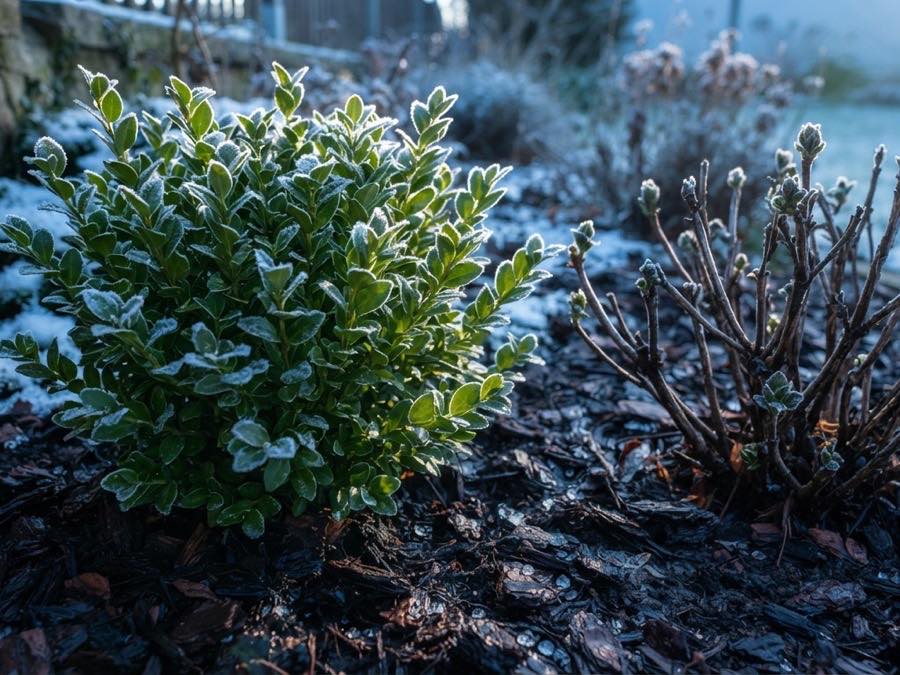
Markham sits in zone 5b, which means an average annual low somewhere around −26 °C. The word doing the work there is average. We plan planting for zone 5a, one step colder, because a single bad February undoes a whole bed otherwise.
Here are nine that have earned their place on our plans, judged on real properties rather than catalogue copy.
Structure that holds through winter
1. Ninebark (Physocarpus opulifolius)
Hardy to zone 3, indifferent to soil, and the dark-leaved cultivars give you deep burgundy from May to October without a single flower. Peeling winter bark keeps it interesting when everything else is bare. It wants space, so give it 1.5 m and stop shearing it into a ball.
2. Boxwood, but only the right cultivars
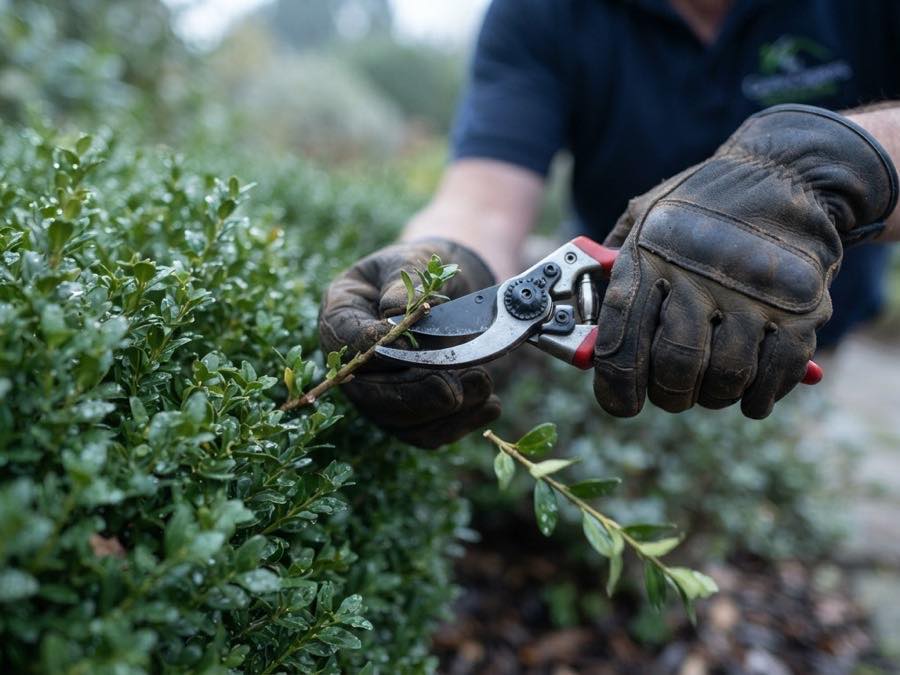
Boxwood is the backbone of most front gardens here and also the plant we replace most often, because the wrong cultivar gets sold constantly. Look for Buxus ‘Green Velvet’ or ‘Green Gem’. Both hold colour through winter and are hardy to zone 4. Avoid English boxwood entirely in this region.
3. Dwarf Korean lilac (Syringa meyeri ‘Palibin’)
Zone 3, tidy without pruning, mildew-resistant where common lilac is not, and it flowers reliably rather than every other year. One of the few shrubs we will plant close to a walkway without worrying about it outgrowing the space.
Perennials that come back stronger
4. Purple coneflower (Echinacea purpurea)
Zone 3, drought-tolerant once established, and the seed heads feed goldfinches through winter if you leave them standing. Buy the straight species or a well-established cultivar; some of the newer novelty colours are markedly less hardy.
5. Black-eyed Susan (Rudbeckia fulgida ‘Goldsturm’)
Zone 3, flowers from late July into September when most beds have gone quiet, and it spreads politely rather than aggressively.
6. Catmint (Nepeta ‘Walker’s Low’)
Zone 3, blooms for months, shrugs off drought, and deer leave it alone. Cut it back hard after the first flush and it does the whole thing again in September.
7. Hosta
Unfashionable and unbeatable in the shade under a maple, where little else will grow. Zone 3. The blue-leaved varieties hold up best against slugs because of their thicker leaf.
Grasses for winter structure
8. Feather reed grass (Calamagrostis ‘Karl Foerster’)
Zone 4, strictly upright so it does not flop onto the lawn, and it stands through snow, giving you vertical interest in January. Cut it back in March, not autumn.
9. Little bluestem (Schizachyrium scoparium)
A native prairie grass, zone 3, that turns copper-orange in autumn and holds that colour all winter. Wants full sun and poor soil, so it thrives in the hell strip by the driveway where nothing else does.
Crape myrtle is sold every spring in Ontario and is zone 7. It dies to the ground and usually does not return. Big-leaf hydrangea (the blue mophead) flowers on old wood that our winters kill, so you get a healthy green shrub with no blooms; plant a panicle hydrangea instead. Japanese maple can work here, but only in a sheltered spot out of west wind, and only if you commit to wrapping it for its first three winters.
The mistake underneath most losses
More plants die here from being planted too deep, or from mulch piled against the stem, than from cold. The root flare, where the trunk widens at the base, should be visible at the soil surface. If you cannot see it, the plant is too deep, and it will decline slowly for years without an obvious cause.
Want a planting plan that lasts?
We design in layers with a scaled drawing and a full plant list, and everything on it is hardy to zone 5a or colder.